Thursday, 29 October 2015

Picking up another thread

The lady next to me picked a loose thread from my sleeve and said "you are going to get a letter".  It is not a saying I had ever heard before so I asked where it came from.  She said it was something her mother said and that her mother was from Yorkshire so perhaps it was a Yorkshire saying.  The thread she found was not very long but apparently if it had been a long thread it would have been a long letter.

It made me wonder about other sayings and traditions there are about threads, so I turned to the internet.

According to one source a loose piece of thread on your clothing also helos those seeking the name of their future love - drop the thread on the floor and see what initial it spells.  

Another source advices tying a thread around the finger of your left hand to help to remember something.  Tying a piece of thread around your little finger is supposed to stop a nose bleed and apparently tying a thread three times around a finger before dropping it to the ground is supposed to remove warts.  

A couple of sources said that if you are sewing and your thread tangles and forms into knots, someone is talking about you, but another source said that a knotted thread indicates an argument.  On the Mediterranean if a thread knots the person whose clothes are being mended will have prosperity and wealth.  

Apparently it is also bad luck to sew clothing while someone is wearing the item unless the person wearing the clothes holds a thread in their mouth.  If however you inadvertently sew something to your own clothes, the number of stitches you make is supposed to indicate the number of lies that will be told about you.

Whilst all these sayings could just be seen as a bit of fun, what I find interesting is the fact that they have get passed down the generations.  Of course we never know where it started and by whom.

Did I receive a letter?  I am still waiting.

Thursday, 22 October 2015

Autumn inspiration


It is not often I find the drive to work a thing of beauty but today, and for the last week or so, it has been almost a joy to drive along tree lined A roads - a riot of greens, yellows, reds, browns, etc. 

A couple of years ago when creating a catalogue for our textile group I asked the E.A.S.T members what their favourite season was - autumn came out on top.  That was not to say that some members did not have other favourite seasons, because each season has it's special pleasures.  It is one of the reasons that although we may moan about the weather in the UK, its constant change is actually one of its assets.

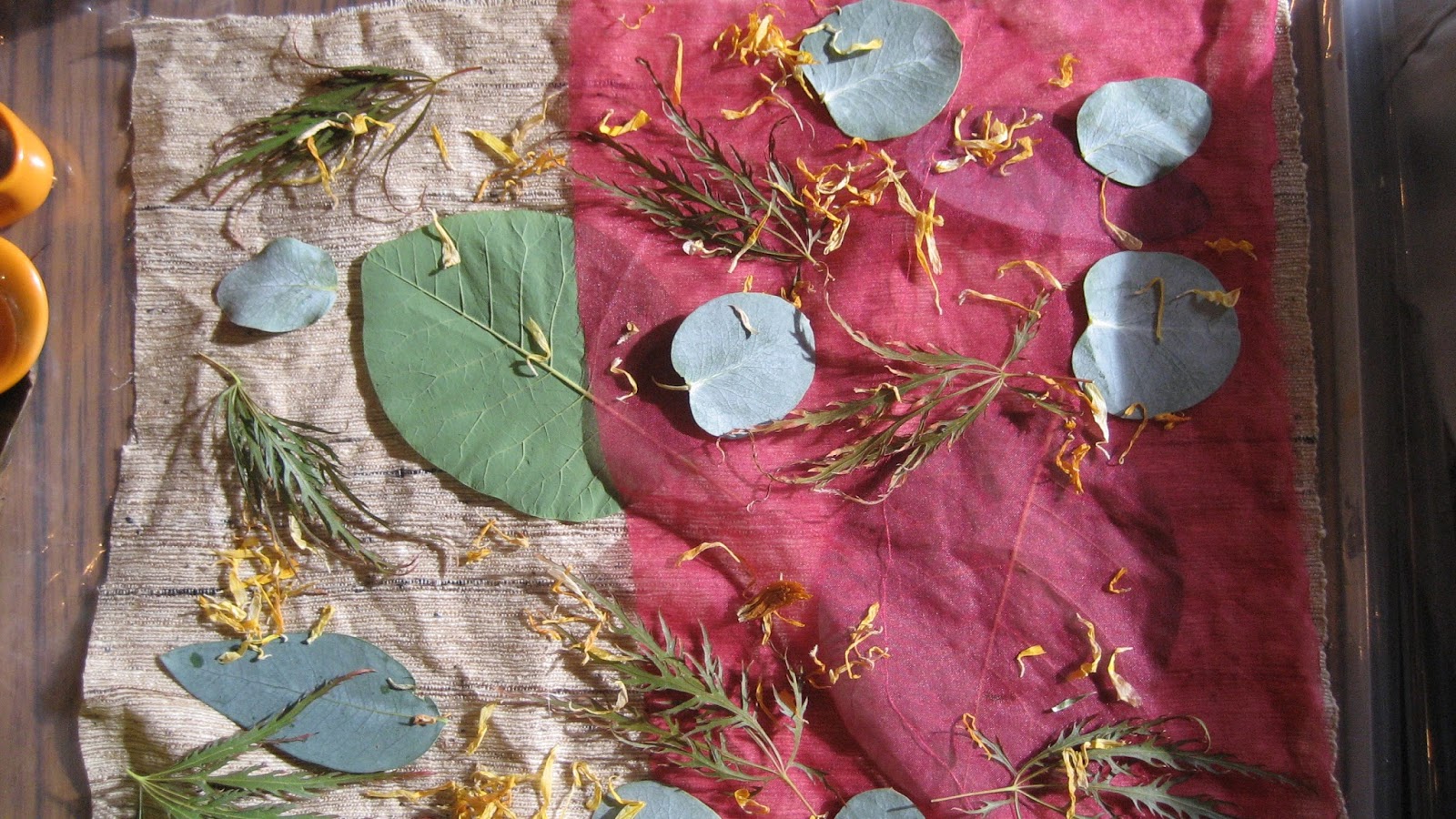
It is for this reason that I thought I would add to last week's blog with some more images of my recent experiments in leaf printing.

First we put our leaves on one half of a piece of vinegar/water soaked silk (or wool) fabric.  Tannin rich leaves work best.  Also there are some pieces of red onion skin here.  The other half of the fabric is then folded over making a sort of "leaf sandwich"


Then the fabric was wrapped really tightly around some rusted tin - I had a spoke from a wheelbarrow but most of the group used tin cans that had been left to rust a little in water.  It also had to be tied very tightly.


The wrapped fabric is then steamed or put into boiling water for an hour or two.  


Some of our fabric was also soaked in a copper water mix as an alternative mordant.


And we also tried techniques out using paper instead of fabric - it even worked for newspaper.


Anyone wanting to learn more about such techniques, might be interested in a celebration of ethical and natural textile practices being organised by "From the Earth".  In May 2016 there will be a whole host of workshops being run through Art Van Go, and an exhibition which is open for applications now (until January 2016) will be held in June 2016.


Thursday, 15 October 2015

Following Threads

The title of the next E.A.S.T (East Anglian Stitched Textile) exhibition is Following a Thread.  I am planning on a body of work inspired by a set of paintings at the National Gallery, but I started out following a very different "thread".

The paintings tell the story of Patient Griselda, a poor country girl who marries a rich marquis, first published in the fourteenth century.  I had researched the paintings as part of an art history course and the more I learnt about the panels, the more there was to find out.  It was not just the narrative illustrated that intrigued but the possibility the panels were commissioned by a woman.  It was a rare thing for a woman to commission art during the Renaissance but not impossible.

However this was not the original inspiration for my E.A.S.T work which began with the story of Elizabeth Blackwell and her Curious Herbal.  My research into Elizabeth Blackwell (1707-1758) had started as a paper I presented at the Foundling Museum last year.  Blackwell engraved all the illustrations as well as all the text.  Her text referred to several sources and it was through this research I came across another botanical illustrator, incidentally yet another remarkable woman. Maria Sibylla Merian (1647-1717) who travelled to Surinam, Africa with her daughter in the 17th and 18th centuries.  Her paintings included not only fantastic plants but insects as well.  Her illustrations were often used as embroidery designs.  Blackwell included some insects in a few of her engravings, perhaps inspired by Merian.

My Blackwell research was also following on from the stories of three remarkable women that lived during WWI which I had used for our last E.A.S.T exhibition, Between the Lines.  One of these WWI women (Mrs Grieve) used her herbal knowledge during the war when commercial medicines were in short supply. I was also learning about herbs during regular visits to the walled garden at Cressing Temple Medieval Barns with a local herbal interest group so it seemed a natural course to combine all these herbal threads.

I read up on herbal dyeing both from a practical and historical point of view and it seemed as if things were coming together. I visited Chelsea Physic Garden, where Blackwell had drawn many of her illustrations and I made a visit to the RHS Lindley Library.  This was a trip organised by the Friends of Thomas Coram and included talks where I learnt more about the printing of herbals and the art of botanical prints.

Despite the fact that I had followed this thread of herbals and herbalists, I was more and more drawn in what seemed a different direction towards the story of the paintings.  Eventually I decided to change to this different source of inspiration, though I worried I had no where to use my extensive herbal research.

Then last weekend E.A.S.T member Jenny, gave us a workshop in how to use leaves to print on fabric and paper (see below).  I realised here was a way my research on the herbals could be linked with the paintings.  I need to find a way of contrasting Griselda's simple country origins with her later wealth and the leaf printing has started me on a train of thought that may provide the solution.


Coincidentally the workshop took place at Braintree Museum, where there is a gallery named after the naturalist John Ray (1627-1705).  Ray was born in nearby Black Notley, Essex. He was a philosopher and scholar.  He was also one of the sources of information Blackwell used for her Curious Herbal. It seemed like pair of threads coming together.

Another dilemma I had was about how to represent Griselda's new found riches and a visit to the aetelier's Hand and Lock, has given me some ideas in that direction.  That visit was combined with a trip to the Queen's Gallery, Buckingham Palace in London, and an exhibition called Painting Paradise: The Art of the Garden (see below). Amongst the paintings and textiles (woven tapestry and embroidery - see below), I was delighted to recognise works by Maria Sibylla Merian, which I had only previously seen in reproduction.  Perhaps that counts as another linking thread?


I now feel my threads of research are coming together - linking my interests in herbs and natural dyes, remarkable women, fourteenth century paintings and hopefully even include a reference to my foundling research.

Thursday, 8 October 2015

Fabric that flies

I have never been a frequent flyer, and to be honest it is for me the least favourite part of any foreign holiday, but I know it is a pretty safe way to travel in a modern, well tested and reasonably comfortable plane.

It is therefore with great admiration that I met someone last weekend who wants to fly in a plane made mainly of fabric and wood (not including the engine, obviously), in a machine I was told while relatively easy to get to into the air, is quite dangerous to land.  There is no also way of keeping out the wind and rain, apart from a thick coat and goggles.


The plane itself is a replica of one previously flown over 100 years ago - a Bleriot XI, and it was brought to the Shuttleworth Uncovered airshow this month, to sit alongside an original that is the oldest piece in the Shuttleworth Collection at Old Warden in Bedfordshire.  

The plane is a fascinating project by a group called the Club Aero des Garrigues from the small French town of Saint Hippolyte-du-Fort.  This town was once celebrated for its three day airshows, known as "Les Batailles".

It was not the only plane made from fabric and stitch at Shuttleworth, several of which flew during the display including some replica Edwardian planes.  Perhaps the most famous fabric plane, that flew was the Hurricane, known for its role in the Battle of Britain which was also commemorated this year.


Apparently the aero club hope their replica Bleriot XI will fly next year, although the pilot told me he had to stay off the gateaux to make that possible, as he too needs to be as light as possible.

But perhaps his dependence on fabric and stitch is still not as daring (or indeed terrifying) as one of the acts that used to part of the original Batailles show.  Apparently the audience were sometimes entertained by a Madame Pelletier whose parachute (a prototype of ones used today), was too bulky to fit in the cockpit of her husband's plane, so Madame Pelletier would launch herself from the wing instead.  Certainly a world away from the highly trained professionals the Red Devils who entertained us at Shuttleworth.


Thursday, 1 October 2015

"... Wonderful things"


When Howard Carter first peered into Tutankhamun's tomb and asked if he could see anything, he is said to have replied, "Yes, Wonderful things".  I was reminded of these words when I visited Alice Anderson's exhibition at the Wellcome Collection - Memory Movement Memory Objects.  

The exhibition is about the act of preserving objects.  The performance and meditative effect of the wrapping process is as important as the objects themselves. The background music added to this effect. The exhibition opens with an opportunity to try some wrapping, including assisting in the wrapping of a car - a full size one - in thread.

It is as you step into the second gallery, that you are bedazzled by the "wonderful things",  In a darkened room, objects stand on plinths, and at the back a staircase - everything wrapped in shimmering, copper thread.  As you walk around the room you are surrounded by objects on these black plinths - so it is only the objects you really see. Yet these were not precious things they were ordinary everyday objects - an electrical plug, a telephone, keys, tools, a Coca Cola bottle, a TV, a record player.  Some were difficult to make out at first but ultimately it was the fun of sudden recognition combined with seeing things differently. Everything was beautifully lit and that added to the drama. Even though it was going nowhere, the staircase pulled you forward with the desire to climb its glittering path. 

In a room with combined objects my first instinct was to work out what was inside - before stepping back to consider them as something new.  Another room was filled with a length of rope or pipe, hung from the ceiling - twisting and turning.  It was like being in a mystical forest - though without the trees.  Then there were collections of objects, laid out on shelves or framed - tiny things like coins, some perhaps simply chosen for their shape.  In the last section there were objects distorted with the wrapping - including a canoe, a wheelbarrow and a set of shelves.  

This is one of those exhibitions that has to be experienced - images do not do it justice.  Even if it is hard to grasp why anyone would want to wrap ordinary things it is worth seeing how the wrapping makes things more beautiful.  In a way it is a bit like looking onto a familiar landscape unexpectedly covered in snow - the familiar is seen in a different light.

The exhibition continues at the Wellcome Collection, Euston Road until 18 October 2015.  It is free to visit.

Thursday, 24 September 2015

An afternoon of silk with tea


Anna Maria Garthwaite was a designer of woven silk in the eighteenth century who, unusually for a woman of that time, not only ran a successful business, but was famous for her design skills during her own lifetime.  Over eight hundred of her watercolours form part of the Victoria and Albert Museum collection and there are examples of silk fabrics made to her designs in museums around the world.  She was born in 1688, the daughter of the Rev Garthwaite and his wife, in Grantham, Lincolnshire.  She had at least one sister, Mary, who was widowed twice.   Anna Maria went to live with Mary in York in the 1720s, before they relocated to Spitalfields a few years later.  Their house, suitably adorned with a blue plaque, still survives in Princelet Street, Spitalfields, London. Occasionally the house is open to visitors.  I do not know if Mary assisted in the business, but I imagine it was likely.  Anna Maria lived until 1763, (until she was 75), and seems to have remained single.


Anna Maria's designs reflected the 18th century love of flowers and plants, partly explained by the interests of natural philosophers (scientists) of that time.  It was her skill in painting flowers in a naturalistic style that made them so appealing. Flower painting was one of the few subjects open to women artists and I know of two others famous for their botanical paintings who lived about the same time.  One was Maria Sibylla Merian (1647-1717) - some of her botanical prints are currently on display at an exhibition on gardens at the Queen's Gallery.  The other was Elizabeth Blackwell (1707-1758) whose drawings were published as  "The Curious Herbal".  What also connects these three women is that they all lived relatively independent lives, both socially and economically and it seems a shame they are not better known.  

Anna Maria was not only artistically gifted but technically skilled.  One of her great innovations was the design of point papers, known as Garthwaite papers, that assisted in the transfer of a painted design to something that could be woven.  They also suggest she knew how to weave.

This was just one of the fascinating insights I learnt when I went to a talk at the Warner Textile Archive in Braintree, Essex last Saturday. The afternoon started with Mary Schoeser, textile historian and President of the Textile Society, who talked about the Spitalfields silk industry and its links with Warners and Braintree.  As I have silk weaving ancestors it also gave me an insight into my own family history.  After the talk we were shown treasures from the archive by archivist, Kate Wigley. Both Kate and Mary were very generous with their knowledge and we had discussions on a range of connected topics throughout the day.   The day finished with a beautiful tea laid on by the archive staff.  It was a day very well organised by the team at Braintree.

The Warner Textile Archive exhibition area is normally open Wednesdays and the first Saturday of each month, and they have a regularly changing exhibition programme.  Researchers and groups can arrange visits and talks and I would highly recommend it as a place to visit.  They also run regular workshops so it is worth signing up for the newsletter.

For more tales of Spitalfields - I also recommend another blog Spitalfields Life.


Thursday, 17 September 2015

Hand & Lock - a textile tardis with 007 on board!


This week I went on a visit to the atelier, Hand & Lock.  Like Dr Who's tardis, the building itself seemed much bigger on the inside than it appeared on the outside (mainly because of the scope of work created within its walls) and we were constantly shifting between the past and the future. We were also given an insight into the secret side of embroidery, which is the 007 component of this blog title.

We were shown around by their excellent Communications Manager, Robert who started with a brief history of the company from its early beginnings as the shop of Mr Hand, who specialised in military work, and who was later joined with Mr Lock, whose specialisation was in fashion. The company now designs and creates work as varied as monogrammed shirts, military badges, items for royalty, pieces for West End Shows as well as unique pieces for artists and the world of haute couture. 


The whole building was bursting to the seams (excuse the pun) with badges and insignia (mainly military) kept ready for dispatch, along with braids and other supplies any self-respecting general or peer of the realm might require. One of their star items is a set of body guard's epaulettes almost ready for the next coronation - they just require the addition of the appropriate insignia which cannot be designed until the next sovereign is known.  It was an interesting reminder of how such occasions have to be planned even though the full preparations might not be needed for decades.

As well as the traditional pieces that Hand & Lock are involved a large part of their output is very contemporary including bespoke embroidery for fashion runway shows - London Fashion Week is one of their busiest times. Skill is obviously important but secrecy is also of the essence. Sometimes the company itself does not know where their designs are going to be used - it can be years later when they spot something and find out its true destination.  

For me one of the highlights of the tour was learning about the development of a design.  Usually starting with pencil and paper, although computers can also be used in designing or, attached to the appropriate machine, stitching.  All the designs start as an annotated drawing marked with techniques required, colour and the direction of stitch etc. In order to explain one of the ways designs are transferred to fabric, we were given a demonstration of a traditional technique - prick and pounce.  A simple leaf design was used to show the development from sketch to a stunning sampler of techniques in gold work and silk shading.


Head Designer, Scott then explained a little more about the techniques of gold work.  He also showed how looking at the back of a piece of work is the best way of understanding how it was created. This cuff was used to demonstrate a range of techniques including elements at different heights and different materials to create contrasts in the design.


Not surprisingly one of the most rewarding aspects of Scott's job is seeing something drawn on paper appearing in the news or in the fashion press.  One such example was a piece of work used in the chair on the royal barge (Gloriana) as part of the Diamond Jubilee celebrations.  

This led on to learning how traditional techniques can also be used in contemporary art and fashion. Individual pieces currently in production have to be kept secret but one recent work we could look at was a piece commissioned for the artist Samantha Roddick who commissioned embroidered work for inclusion in her photographic work - "Hidden Within", an exploration of the objectification of women.

We completed the day with a mention of their workshops and their annual competition that encourages expertise in hand embroidery.  The competition provides a platform to display the range of talent and skill of individual artists.  Another way of promoting contemporary embroidery is in their use of a window display to showcase textile art and something worth looking out for if you are in the area of Margaret Street, London.